Herbs for hot flashes: which ones to use and what precautions to take
There are many plants that can soothe hot flashes, both with and without phytohormones. Pharmacist and author Carole Minker explains how they affect the chain reaction and what precautions you should take.

Melisande
Founder of Reflet 🫶
Publié le16.10.2026 Modifié le21.11.2026
Sage infusions, saffron capsules, grandmother's remedies shared in Facebook groups: when hot flashes set in, many women turn to plants. They are right to consider them: several plants can help. But not just any plant, and not for everyone.
In our seriesGénération Péri, the pharmacistCarole Minker explains that hot flashes are a chain reaction, and that each link in this chain offers a point of intervention. This allows you to choose a plant based on how it works and what your body can tolerate.
Why plants can help with hot flashes
As a reminder, hot flashes follow several stages, which Carole details in the episode:
- Estrogen levels fluctuate.
- The brain's thermostat (the hypothalamus) becomes dysregulated and believes the body is overheating.
- The nervous system and inflammation amplify this signal.
- Skin blood vessels dilate to release heat that isn't actually there.
Plants can act at different levels of this chain: on hormones, the nervous system, or blood vessels. To understand the mechanism in detail, read our guide on hot flashes.
Plants that act on hormones: phytoestrogens
These are the most well-known and often the first ones you will be advised to try.
- Sage, the classic remedy for hot flashes;
- hops;
- red clover;
- soy, rich in isoflavones.
They contain phytoestrogens, molecules that mimic our estrogen. Since hormonal fluctuation is what triggers hot flashes, they can be worth considering, Carole acknowledges.
But they do have significant contraindications. They should be avoided if you have a personal history of hormone-dependent cancer, and discussed with a doctor if you have a family history, hormonal conditions, or are undergoing hormone therapy. We provide a full overview in our article on phytoestrogens.
Sage used to season your food is not a problem. It is the concentrated extracts, in capsules or drops, that require caution.
Plants that soothe the nervous system
Saffron, the most studied active ingredient
This is the plant Carole focuses on the most. "A medicinal plant that I love, which is truly very precious." Saffron is used here for its effect on the nervous system. It acts on serotonin, but also on other neurotransmitters and on inflammation. The result: it can help with anxiety, mood, and hot flashes by acting on the nervous link in the chain.
Above all, saffron benefits from numerous clinical studies. Carole explains how they work: women experiencing hot flashes are divided into groups, one receives saffron, the other a placebo, often without either the women or the caregivers knowing who is taking what (this is called a double-blind study). The results are then compared.
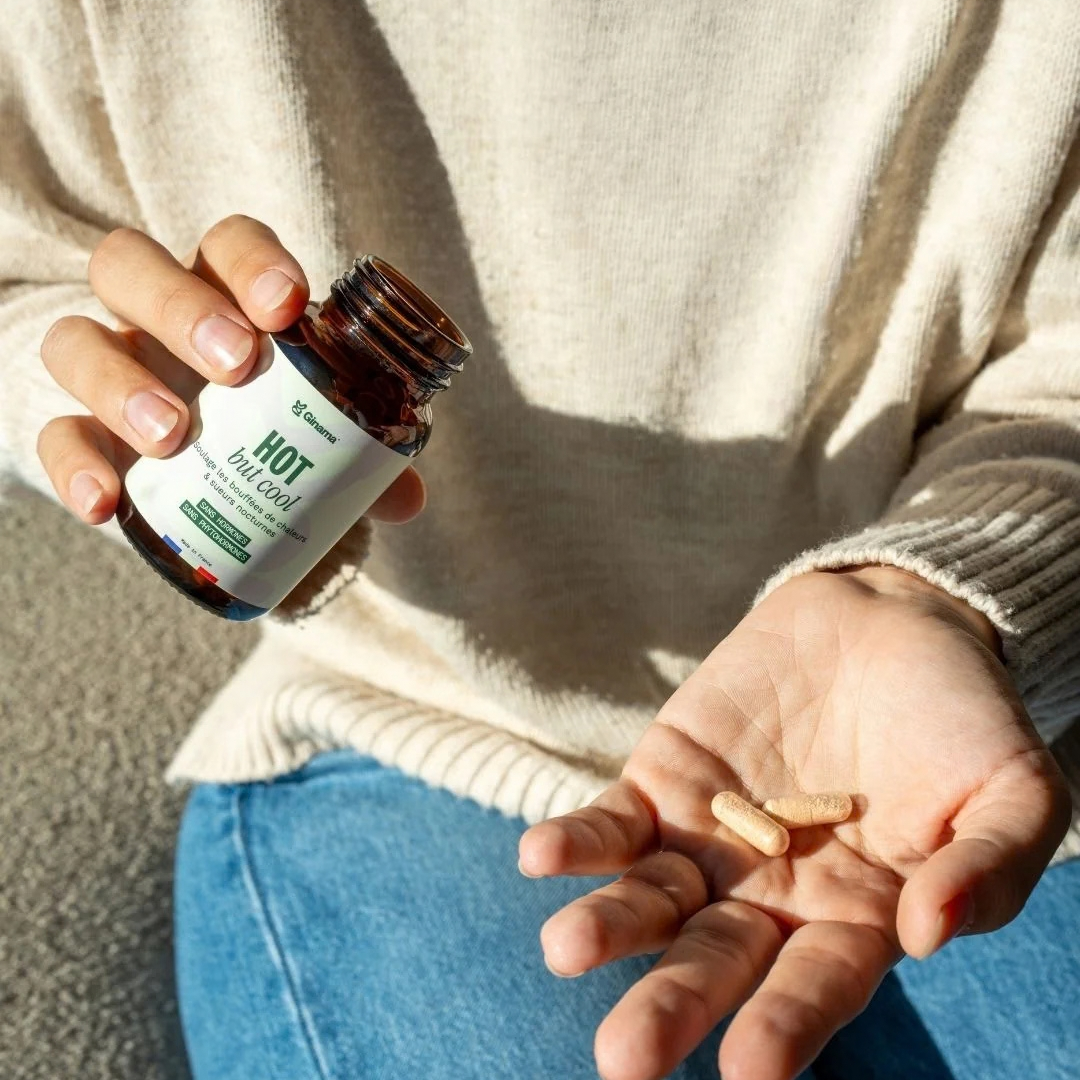
Saffron does not contain phytohormones. It is the core active ingredient in the supplement from Ginama dedicated to hot flashes, a partner brand of this series.
Precautions : saffron supplements are not recommended during pregnancy. Follow the indicated dosages, and seek advice if you are taking any medication, particularly antidepressants.
Vitamin B6, paired with saffron
Carole pairs it with saffron in what she calls the "thermostat and mood" duo. Vitamin B6 helps regulate hormonal activity, acting at the very source of the chain.
Adaptogenic plants
Kelly Colonges, a doctor of plant biology and herbalist, suggests holy basil (tulsi), an adaptogenic plant that helps the body better adapt to stress. She pairs it with sweet clover for women looking for a solution without phytohormones (see below). We tell you more in our guide to medicinal plants.
Plants that act on blood vessels
Hot flashes are caused by the dilation of blood vessels in the skin. This is why, according to Carole, circulatory plants :
- red vine;
- witch hazel;
- sweet clover, which Kelly Colonges also cites for its effect on hot flashes.
Precautions : sweet clover contains compounds that can interact with anticoagulants. If you are taking blood-thinning medication, consult your doctor or pharmacist before using any circulatory plants. Also read our article on medicinal plants and medications.
The skin, at the end of the chain: borage and vitamin E
Carole has devised a second duo, dubbed "furnace and tissue": borage oilandvitamin E. Borage oil has an overall anti-inflammatory effect and supports skin health, which is where hot flashes manifest. Vitamin E, an antioxidant, often accompanies it. This is particularly useful for women with reactive skin, rosacea, or visible small blood vessels. The idea, summarizes Carole, is to act at both the start and the end of the flash.
These two active ingredients are also part of the Ginama formula, along with saffron, vitamin B6, and vitamin B9.
Progesterone-like plants
Carole also mentions other plants, known as phytoprogestogenic : they are thought to act in a way similar to progesterone. She cites:
- lady's mantle;
- yarrow, which has the added benefit of being a circulatory herb.
These are also plants with hormonal activity: they require professional advice, particularly in cases of pregnancy, hormonal conditions, or allergies to plants in the Asteraceae family in the case of yarrow.
What about apple tree buds?
This is another traditional approach, mentioned by Kelly Colonges in her Reflet 100% Naturel episode. Apple tree gemmotherapy is known to produce good results for hot flashes. However, as a precaution, it is contraindicated in hormone-dependent situations: it is not yet known whether it contains phytohormones, but it appears to behave in a similar way.
Old wives' tales: are they worth it?
Herbal teas, cool compresses, cold water on the wrists: many traditional remedies are based on sound principles, especially those that use cold. Carole explains that cold really does help, particularly perineal cryotherapy (a cold gel pack wrapped in a cloth applied to the perineum) or a cold pack on the neck. According to her, these methods have no side effects or interactions.
On the other hand, be wary of unmeasured herbal blends or protocols found online: a plant may have contraindications, and combining several plants that act in the same way can amplify their effects.
Rather than using many different plants, it is better to choose one or two, properly dosed, and observe the effect over a few weeks.
How to choose your plant
This table provides guidelines and is not a substitute for personalized advice. Also, keep duration in mind: a course of herbs or supplements should be evaluated over several weeks, not a few days. To choose the right supplement, read our article on food supplements during perimenopause.
Herbs: one solution among many
As Carole points out, herbs are just one part of a range of solutions. Cooling techniques, soothing the vagus nerve (yoga, breathing, heart coherence), light clothing, supplements, and, when indicated, hormone therapy discussed with your doctor. "Everyone needs to find what suits them and what works for them." For difficult nights, read our article on night sweats, and find our content onperimenopauseandmenopause.
Discover the episode with Carole Minker
Discover the Generation Peri series
Key takeaways
- Herbs can act on different levels: hormones, the nervous system, blood vessels, and the skin.
- Phytoestrogens (sage, soy, hops, red clover) are effective for some, but are contraindicated if you have a history of hormone-dependent cancer.
- Saffron is one of the most studied active ingredients, and it does not contain phytohormones.
- Circulatory herbs (red vine, witch hazel, sweet clover) act on blood vessels; use caution if you are on anticoagulants.
- Cold remains a simple remedy with no side effects, which can be combined with other approaches.
FAQ
Which herb is most effective against hot flashes?
There is no miracle herb. Saffron is among the most studied active ingredients. Sage is a classic, but it contains phytoestrogens. The right choice depends on your medical history.
Which herbs should be avoided if you have a history of breast cancer?
Herbs containing phytoestrogens (sage, soy, hops, red clover) and, as a precaution, apple bud. Always speak to your oncologist or doctor before taking any herbs.
Is saffron safe?
It is well-tolerated at recommended doses but is not recommended during pregnancy. Seek advice if you are taking any medication, especially antidepressants.
Do sage herbal teas work?
Sage is traditionally used for hot flashes. It contains phytoestrogens, so it is not suitable if you have a history of hormone-dependent cancer.
Are there natural solutions that don't involve herbs?
Yes: cold (a cold pack on the neck or perineum), light clothing, slow breathing, yoga, or heart coherence.
The information in this article is for educational purposes only and does not replace professional medical advice. The Génération Péri series is produced in partnership with Ginama. Kelly Colonges is a doctor of plant biology and an herbalist; she is not a healthcare professional. Before taking any herb or supplement, especially if you have a history of cancer, are currently on medication (hormonal, anticoagulant, antidepressant), or are pregnant or breastfeeding, consult your doctor or pharmacist.
Which plant is most effective against hot flashes?
Programs that could help
Les Séries Santé recommandés

Do we freeze our oocytes?
Le Rubis is the first podcast dedicated to egg freezing. I answer all your questions about this journey, I wonder about the emotional impacts of this approach and I give you the keys to take action , as long as it's your choice! If you asked yourself the question Once in your life, Le Rubis is made for you. Available only in French speaking.
I discover the Ruby