Electrolysis and thermolysis hair removal: how it works, face, reviews
As the oldest permanent hair removal method in the world, electro-epilation remains little-known in France. Stéphanie Prudhomme, founder of Dermalyse and trainer, explains the difference between electrolysis and thermolysis, and everything you need to know before starting.


Melisande
Founder of Reflet 🫶
Publié le16.10.2026 Modifié le01.11.2026
It is "the oldest permanent hair removal method in the world," yet one of the least known. Electro-epilation has existed for over 150 years, long before lasers. Stéphanie Prudhomme, founder of Dermalyse, a clinic specializing in thermolysis in Chessy (near Disneyland Paris), and an Apilus-certified trainer, regrets this paradox: "I can say that it is the oldest permanent hair removal method in the world, and yet, I find it is the least known."
If you have hair on your chin, face, or chest related to your hormones, this article is for you. We asked Stéphanie everything: how it works, how long it takes, what it feels like, and how to choose the right practitioner.
The two main categories of permanent hair removal
Stéphanie distinguishes between two categories:
- Photo-epilation : laserandpulsed light, which use light to heat and destroy the hair.
- Electro-epilation :electrolysis,thermolysisandblendwhich use an electric current, applied hair by hair.
Laser and intense pulsed light at a glance
Laser is highly effective: Stéphanie reports 80 to 90% hair reduction on suitable areas. Intense pulsed light works on the same principle but with a less precise beam (polychromatic, whereas the laser is monochromatic): it requires more sessions, though the results remain satisfactory. Modern devices cool the skin with forced air, making the sessions more tolerable.
Their limitations:
- skin phototypes : for dark to black skin, a specialized device (such as an Nd:YAG laser) is required to prevent burns;
- hair that is too light or too fine, which does not respond;
- tattooed skinandtanned skin;
- hormone-dependent areas (chin, jawline, areolas, stomach line), where they risk causing paradoxical hypertrichosis, which is denser than before.
It is precisely for these situations that electrolysis becomes the preferred solution.
Electrolysis: a medically-derived method
Electrolysis was invented in 1875 by an American ophthalmologist. He was treating war veterans whose eyelids, injured by shrapnel, were causing eyelashes to grow inward toward the eye. Rather than constantly plucking them, he had the idea of inserting a needle charged with current to destroy the cells responsible for regrowth. "At its core, this is truly a purely medical method," explains Stéphanie.
Electrolysis uses a galvanic current, which is a direct current. It has its limitations:
- it is slow : you had to stay in each follicle for several seconds;
- it was painful and generated a lot of heat;
- the conical needles could leave pitted scars.
Stéphanie's mother had her lower legs treated with electrolysis 25 years ago, hair by hair, in fifteen-minute sessions at most because it was so hard to endure. Today in France, electrolysis is reserved for doctors.
Thermolysis: the gentler evolution
Thermolysis is the evolution of electrolysis. It is the technique that Stéphanie practices.
- The current : a high-frequency, alternating current, which is much gentler and faster.
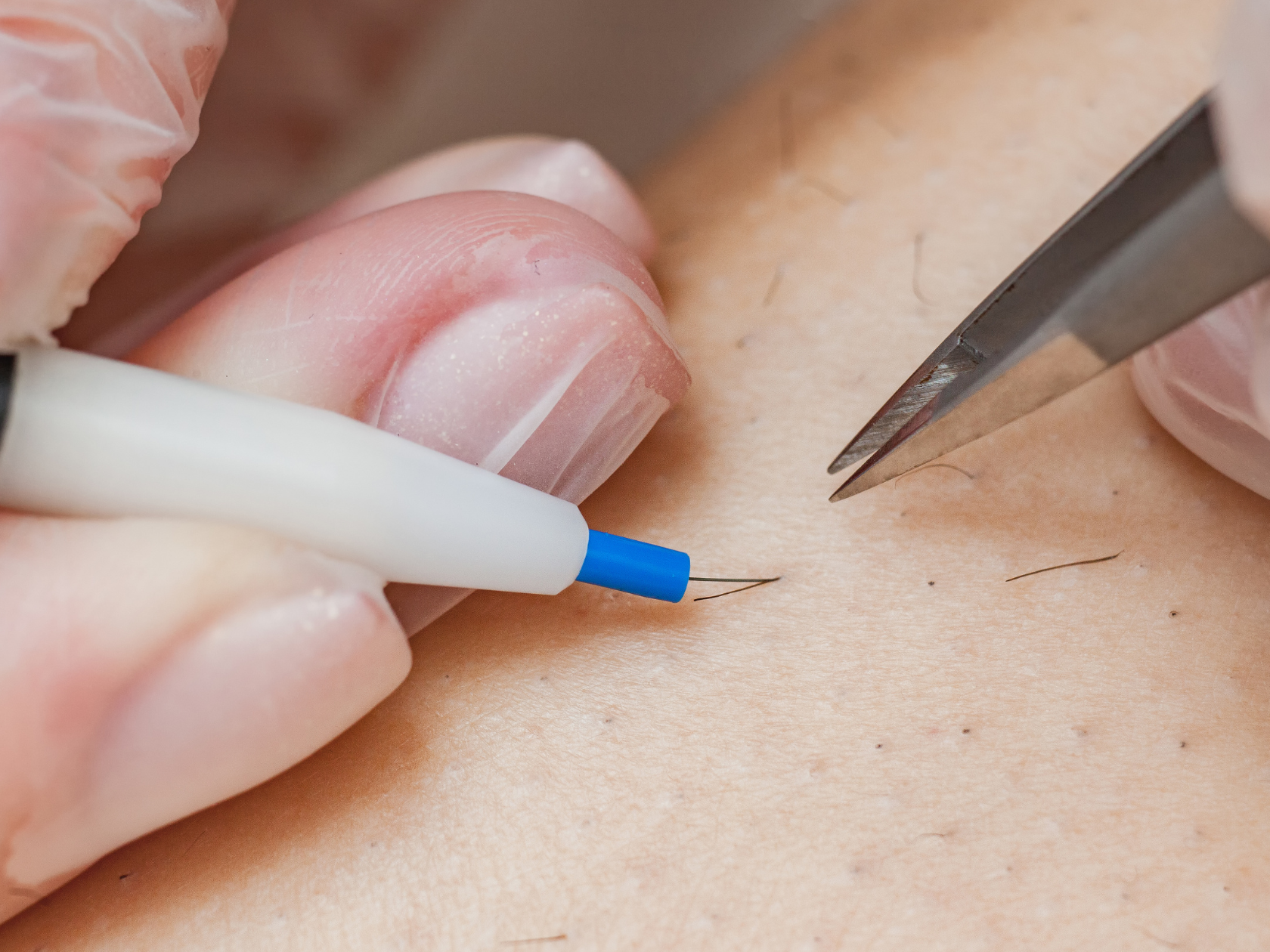
- The tool : a microfilament that looks like a needle, but with a flat base, and not pointed.
- The technique : the microfilament is slid along the hair, into the skin's natural opening, down to the follicle. There is no skin perforation. Stéphanie compares it to a flower in a bud vase: you slide between the stem and the side of the vase, without leaving the container.
- The action : the current coagulates the cells responsible for hair regrowth.
Thermolysis can be performed by estheticians, nurses and doctors who are trained in the procedure. It is very meticulous work, performed under a magnifying lamp.
What about the blend method?
The blend method combines galvanic and high-frequency currents to treat very stubborn hair. Because it uses galvanic current, it is prohibited for estheticians and nurses. According to Stéphanie, modern devices offer modes that rival the blend method without the need for galvanic current, making it less necessary today.
Comparison of methods
What happens during a thermolysis session
The mandatory initial consultation
At Dermalyse, it lasts 45 minutes. It’s "our signature," says Stéphanie. We review your health, treatments, supplements, skincare routine, and medical history to ensure there are no contraindications. It is not a medical diagnosis, she clarifies: "We are not doctors, and we don't claim to be."
We also perform a test on the area to be treated. This allows you to get a feel for the sensation, puts your mind at ease, and helps us find the right settings: according to Stéphanie, an Apilus device offers over 29,000 parameter combinations. Finally, it allows us to observe how your skin heals.
What to expect during a session
- Disinfection of the area.
- Insertion of the microfilament into each follicle to be treated, under a magnifying lamp.
- Current pulse, hair by hair.
- Re-disinfection, followed by the application of a soothing cream.
- Sunscreen if you are going outside, as the skin can become pigmented after the treatment.
What it feels like
Stéphanie describes a brief, tingling heat. "It's not the most pleasant thing in the world, but it's certainly not unbearable." Sensitivity varies from person to person, and even from one session to the next: you may be more sensitive during your period or when you are tired.
How long does the treatment take?
This is the most important point to understand. Thermolysis is effective, but time-consuming.
Why multiple sessions are necessary
Hair has three growth phases: anagen (growth), catagen (transition) and telogen (resting). All permanent hair removal methods are only fully effective during the anagen phase. Stéphanie uses a very vivid analogy, suggested by her daughter: bowling.
- Hair in the anagen phase : it's a strike. All the cells responsible for regrowth are destroyed, and the hair will not return.
- Hair in the catagen phase : it's a spare. A few "pins" remain; the hair is weakened but may return.
- Hair in the telogen phase : the ball ends up in the gutter. No cells are destroyed.
And since our hair doesn't all grow at the same time (thankfully, otherwise we would alternate between having "Monica Bellucci's hair" and no hair at all), each session only treats a portion.
Expected duration
- Face without hormonal issues : generally 12 to 18 months of treatment.
- Face with a hormonal diagnosis (PCOS, etc.) : more like 24 months, with results appearing later but proving very effective.
- Frequency : usually one session per week at the start for the face, then increasingly spaced out.
- Session duration : from a few seconds to an hour, depending on the density and what you wish to treat.
Pricing
It is not possible to provide a total quote at the first appointment: thermolysis is billed by session time, and this time varies for each person. As Stéphanie writes on her website: "Every story is different, and so are our protocols."
Contraindications
Major contraindications, common to all electrolysis techniques:
- a pacemaker or any other implanted electronic device;
- certain types of diabetesandcertain forms of epilepsy;
- isotretinoin treatment (Roaccutane, for acne): no sessions during treatment, or in the 6 months following it. Stéphanie prefers to wait about a year after stopping.
Pregnancy : electrolysis is ruled out. For thermolysis, there are two schools of thought; Stéphanie has chosen not to treat pregnant women as a precaution, especially after supporting many women through IVF journeys. She advises them to return to their usual hair removal method and come back afterward.
Other points of caution are checked during the consultation: skincare routine, supplements, medications, and lifestyle habits.
During treatment, no more waxing, tweezing, threading, or shaving: the hairs must be visible to be treated.
How to choose your practitioner
For Stéphanie, two criteria are non-negotiable:
- A proper initial consultation, which assesses your health and adjusts the treatment over time.
- The vibe : "We're entering people's personal space." You need to feel comfortable.
To practice, you must be an aesthetician, nurse, or doctor, and complete specific training. The program taught by Stéphanie, as an authorized Apilus trainer, includes eight theoretical modules (skin, endocrine system, hair anatomy, etc.) validated by quizzes before moving on to practice. Centers trained in the Apilus method are listed on a map at apilus.fr. Don't be surprised if you have to travel: some of Stéphanie's clients drive two hours for five-minute sessions toward the end of their treatment.
The pros and cons of thermolysis
The pros : all areas (except mucous membranes), all skin types, all seasons, light hair, and tattooed skin, with no paradoxical hair growth.
The cons : a hair-by-hair method with gradual results, a long treatment process, and no way to provide a flat-rate quote at the start.
To understand where this hair comes from, read our guide on hirsutism, our article onchin hairand the one onPCOS and body hair.
Discover the episode with Stéphanie Prudhomme
Also check out our content on PCOS.
Discover the Reflet PCOS / PCOD journey
Key takeaways
- Electro-epilation has been around since 1875: electrolysis (reserved for doctors), thermolysis, and blend.
- Thermolysis uses a high-frequency current and a flat-based microfilament, without piercing the skin.
- It is the preferred method for hormone-dependent areas, where laser treatment risks causing paradoxical hair growth.
- Expect 12 to 18 months for the face, and more like 24 months in cases of PCOS.
- An initial consultation with a test is essential, and certain contraindications must be checked.
FAQ
What is the difference between electrolysis and thermolysis?
Electrolysis uses direct current and needles; it is reserved for medical professionals. Thermolysis uses a high-frequency current, which is gentler and faster, with a flat-based microfilament.
Does thermolysis hurt?
You will feel a brief sensation of heat and tingling. It is uncomfortable but manageable, and sensitivity varies from person to person and from day to day.
Is thermolysis really permanent?
According to Stéphanie Prudhomme, yes: a hair destroyed during its growth phase will not grow back. However, multiple sessions are required to treat all the hair.
Can thermolysis be performed on the face?
Yes, it is actually the preferred method for the chin and jawline, which are hormone-dependent areas.
How much does thermolysis cost?
The price depends on the session time, which varies for each person; it is not possible to provide a total quote at the first appointment.
The information in this article is for informational purposes only and does not replace the advice of a healthcare professional. Stéphanie Prudhomme is a permanent hair removal practitioner and certified trainer; she is not a healthcare professional. If you have any doubts regarding a contraindication, seek your doctor's advice before starting treatment.
What is the difference between electrolysis and thermolysis?
Programs that could help

Les Séries Santé recommandés

Do we freeze our oocytes?
Le Rubis is the first podcast dedicated to egg freezing. I answer all your questions about this journey, I wonder about the emotional impacts of this approach and I give you the keys to take action , as long as it's your choice! If you asked yourself the question Once in your life, Le Rubis is made for you. Available only in French speaking.
I discover the Ruby